
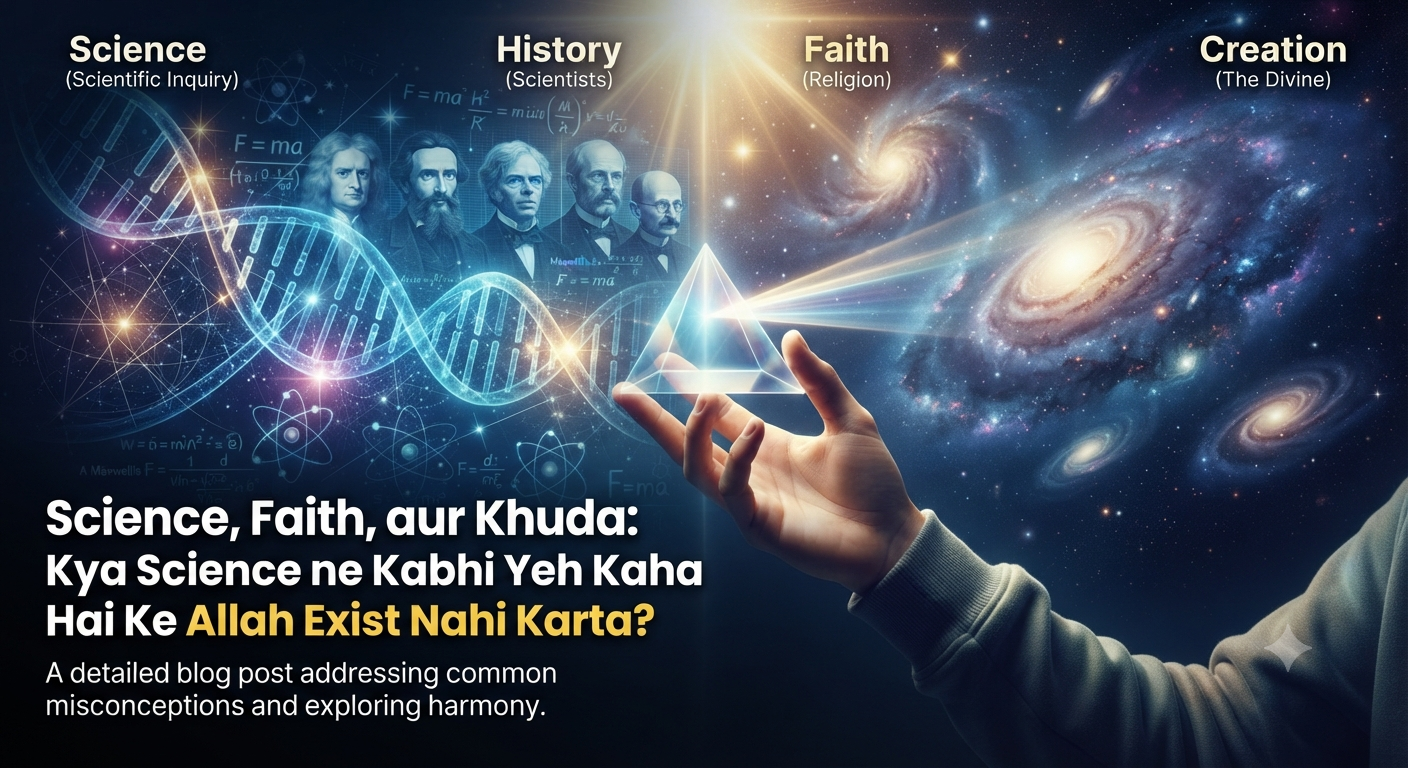
Aajkal internet scroll karte waqt, YouTube shorts dekhte waqt ya Twitter/X par feed check karte waqt ek common trend dekhne ko milta hai. Koi bhi popular internet creator, tech influencer, ya celebrity uthta hai aur confidence ke sath bol deta hai: “Bhai, ab zamana badal gaya hai, science itni aage nikal aayi hai ke ab God ya Khuda ki koi zaroorat nahi hai. Science ne prove kar diya hai sab kuch apne aap hua hai.”
Jaise abhi haal hi me Dhruv Rathee ya aise kai digital creators ne is topic par apne opinions diye hain. Log in baaton ko sach maan lete hain kyunki unhe lagta hai ke agar koi banda million subscribers wala hai, toh use duniya ki har cheez ki deep knowledge hogi.
Lekin rukhiye! Kya sach me science ne kabhi aisi koi official declaration di hai? Kya laboratory me microscope ke andar ya particle accelerator me koi aisi cheez mili hai jo 100% ye prove karde ke upar wala koi Creator exist nahi karta?
Aaj is article me hum bilkul khulkar, history ke facts ke sath, science ki limits ko samajhte hue, aur world ke sabse legendary scientists ke mindsets ko explore karte hue is poori myth ko todne wale hain. Grab your coffee, aur aaiye deep dive karte hain!
1. The Internet Echo Chamber: Why Do People Think Science = Atheism?
Sabse pehle ye samajhna zaroori hai ki ye narrative aati kahan se hai. Aajkal ek culture ban gaya hai jise “Pop Science” kehte hain. Isme complex scientific theories ko tod-marod kar social media ke 30-second ke reels ya 10-minute ke videos me aise pesh kiya jata hai jaise science aur religion ek dusre ke sabse bade dushman hon.
Yahan kuch common misconceptions hote hain:
- The “God of the Gaps” Fallacy: Purane zamane me log jab bijli (lightning) ya baarish ka reason nahi samajh pate the, toh kehte the ke direct upar wale ki marzi hai. Jaise-jaise science ne explain kiya ki clouds kaise bante hain aur electricity kya hai, kuch logo ko laga ke ab God ki jobless hone ki baari aa gayi hai.
- Celebrity Bias: Log kisi digital creator ko tech ya political topics par acha bolte hue dekhte hain, toh unhe lagta hai ki wo philosophy of science ke bhi expert honge. Jabki reality ye hai ki zyadatar pop-culture commentators scientific philosophy ki deep books ya history ko touch tak nahi karte.
Lekin asli scientists aur top-tier academic institutions kya sochte hain? Let’s look at the official facts.
2. What Does Official Science Say? (The Stance of the National Academy of Sciences)
Agar aapko yeh janna hai ke modern science formally kya manti hai, toh aapko kisi random YouTuber ki baat nahi sunani chahiye, balki duniya ki sabse prestigious scientific bodies ki official statements dekhni chahiyein.
Inme sabse top par aati hai National Academy of Sciences (NAS) jo ki United States ki sabse respected scientific organization hai. Unhone is topic par ek dedicated publication nikali hai jiska naam hai: “Science, Evolution, and Creationism”.
Is official publication me NAS ne bilkul clear aur bold words me likha hai:
“Science can neither prove nor disprove religion.”
Is line ka matlab kya hai? Iska matlab yeh hai ke science ka scope bilkul defined hai. Science sirf empirical evidence (jo cheezein aap dekh sakte hain, measure kar sakte hain, test kar sakte hain aur lab me replicate kar sakte hain) par kaam karti hai.
- Methodological Naturalism: Science sirf yeh batati hai ke physical duniya ke rules kya hain. Jaise paani $100^\circ\text{C}$ par boil kyun hota hai? Gravity kaise cheeezon ko khichti hai?
- The Metaphysical Limit: Lekin science yeh nahi bata sakti ke gravity bani hi kyun? Ya is poori universe ke hone ka ultimate maqsad (purpose) kya hai? Yeh questions philosophy aur religion ke hain. Isliye, science aur religion ek dusre ke opposite nahi hain, balki dono human experience ke alag-alag dimensions ko deal karte hain. Ek batati hai “How” (kaise hota hai), aur dusri batati hai “Why” (kyun hota hai).
3. History Ke Giants: The Greatest Scientists Were Theists!
Agar hum pichle 500 se 1000 saal ki history utha kar dekhein aur un logo ki list banayein jinhone actual me physics, mathematics, astronomy, aur chemistry ki duniya ko banaya ya revolutionize kiya, toh aap ek shocker dekhenge. Zyadatar legendary scientists strong theists the—yaani wo Khuda par, divine order par, aur ek Supreme Creator par deep yaqeen rakhte the.
Aaiye inme se kuch sabse bade naam aur unke exact quotes dekhte hain:
A. Sir Isaac Newton (Physics & Mathematics)
Newton ko modern physics ka baap kaha jata hai. Unhone laws of motion diye, calculus banaya, aur gravity ki khoj ki. Lekin kya aapante hain ki Newton ne apne scientific papers se zyada time theology (religious studies) aur Bible ki study par spend kiya tha?
Apni legendary book Philosophiae Naturalis Principia Mathematica ke General Scholium section me Newton ne likha tha:
“This most beautiful system of the sun, planets, and comets, could only proceed from the counsel and dominion of an intelligent and powerful Being.” (Translation: Itna khubsurat solar system aur planets ka movement kisi aisi powerful aur intelligent hasti ke bina nahi ho sakta tha.)
B. Johannes Kepler (Astronomy)
Kepler wo brilliant astronomer hain jinhone planets ke orbits ke rules (Kepler’s Laws) discover kiye, jiske bina modern space science ka sochna bhi impossible hai. Kepler ek deep Christian theist the aur unka manna tha ke jab wo space aur stars ki study karte hain, toh wo literally God ke banaye hue blueprint ko padh rahe hain. Unka famous quote hai:
“I was merely thinking God’s thoughts after Him.”
C. Michael Faraday (Electromagnetism)
Aaj humare paas jo electricity, generators aur electric motors hain, unke peeche Michael Faraday ka dimag hai. Faraday apni poori life me ek devout Christian church member rahe. Wo hamesha nature ko “God’s creation” kehte the aur unka manna tha ke scientific laws ko decode karna ek tarah se Creator ki greatness ko aur zyada close se admire karna hai.
D. James Clerk Maxwell (Electromagnetism)
Maxwell wo genius hain jinhone electricity, magnetism aur light ko ek hi equation me unite kiya (Maxwell’s Equations). Unhone publically hamesha apne Christian faith ko express kiya aur unka strict belief tha ke science aur faith ke beech koi conflict ho hi nahi sakta, kyunki dono ka source ek hi truth hai.
E. Max Planck (Quantum Physics)
Jab 20th century me physics me quantum mechanics aayi, toh Max Planck uske pioneer bane. Planck ka science aur religion ke relation par ek bohot hi deep aur famous lecture hai (1937 me), jisme unhone kaha tha:
“Religion and natural science are fighting a joint battle in an incessant, never-ceasing crusade against skepticism… with the rallying cry: ‘On to God!’”
4. The Truth About Evolution and Modern Skeptics
Ab aate hain us sabse bade weapon par jo internet atheists use karte hain—Theory of Evolution. Log sochte hain ke agar humans aur animals evolution ke through aaye hain, toh iska matlab God ka koi concept hi khatam ho gaya. Lekin yahan bhi reality bohot alag hai:
- Charles Darwin Ki Apni Journey: Charles Darwin ne Jab On the Origin of Species likhi, toh unka initial view thoda critical tha, lekin apni poori life ke end tak aate-aate Darwin ne kabhi bhi khud ko ek militant ya strict atheist declare nahi kiya. In fact, kai letters me unhone khud ke liye “agnostic” term use kiya, kyunki unka manna tha ke universe ki itni vast complexity ko poori tarah se explain karna human brain ke liye ek limit rakhta hai.
- Richard Dawkins’ Cultural Turn: “New Atheism” movement ke sabse bade face, jinhone The God Delusion jaisi famous kitab likhi—yani Richard Dawkins—hone kuch saal pehle media me ek aisi baat kahi jo unke fans ke liye shock thi. Dawkins ne khud ko ek “Cultural Christian” declare kiya! Unhone ye maana ki chahe wo theological level par God ko believe na karte hon, lekin society me Christian values, ethics, aur culture ka hona civilization ke survival ke liye bohot zaroori hai.
5. Propaganda, Clout, And Why You Shouldn’t Fall For It
Aaj ke digital era me information se zyada attention economy chalti hai. Jo cheez jitni controversial hogi, jitni zyada shock-value rakhti hogi, algorithm usko utna hi upar push karega.
Jab koi influencer ya public figure bina kisi deep philosophical background ke ye bol deta hai ke “Science ne prove kar diya God nahi hai,” toh wo asal me do cheezein kar raha hota hai:
- Clout Chasing: Bold statements jaldi viral hote hain.
- Lack of Epistemological Depth: Unhe khud nahi pata hota ke science ki apni limitations kya hain. Science mechanisms padhati hai, meaning nahi.
Ek science student jab deeper level par physics, quantum mechanics, ya molecular biology padhta hai, toh wo dekhta hai ke universe ke laws kitne zyada fine-tuned hain. Thoda sa bhi farq ho toh life exist hi na kare (ise Fine-Tuning Argument kehte hain). Isliye duniya ke kai top modern scientists bhi aaj bhi deeply spiritual ya theist hain.
Conclusion: Don’t Compromise Your Faith For Social Media Trends
Asal baat yeh hai ke science aur faith ek dusre ke dushman nahi hain, balki ek dusre ke complement hain. Science aapko yeh batati hai ke duniya ka machinery kaise chalti hai, aur faith aapko yeh batati hai ke iske peeche ka ultimate maqsad kya hai.
Kisi popular celebrity ya internet creator ki bas isliye andhi naqal mat kijiye kyunki unke paas followers bohot zyada hain. Apni thinking ko critical banaiye, books padiye, history explore kijiye, aur khud decide kijiye. Science padhne se agar kuch hota hai, toh wo sirf yeh hota hai ke aapki aakhon ke samne universe ki khoobsurati aur zyada clear ho jati hai—aur ek sacha scientist wahan sirf random chance nahi, balki ek deep, intelligent design dekhta hai.
References & Further Reading for the Curious Mind:
- National Academy of Sciences & Institute of Medicine. Science, Evolution, and Creationism. Washington, DC: The National Academies Press, 2008.
- Newton, Isaac. Philosophiae Naturalis Principia Mathematica (Mathematical Principles of Natural Philosophy), General Scholium, 1713.
- Planck, Max. Religion und Naturwissenschaft (Religion and Natural Science), lecture delivered in 1937 at the University of Kiel.
- Kepler, Johannes. Mysterium Cosmographicum (The Cosmographic Mystery), 1596.
- Dawkins, Richard. The God Delusion, Houghton Mifflin Harcourt, 2006 (along with his later interviews addressing cultural Christianity).