
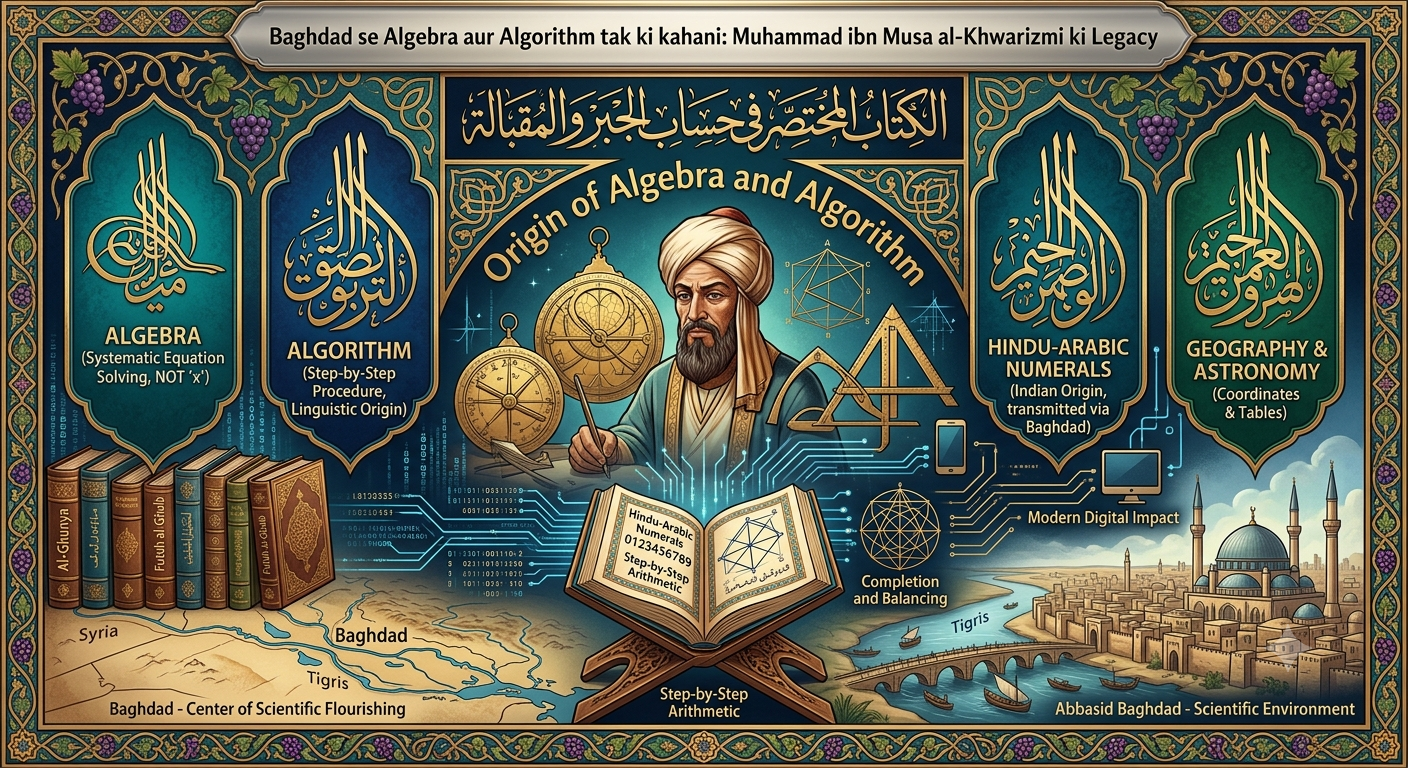
⏱️ 2-Minute Read — In Short
Aaj hum Algebra padhte hain, Algorithms use karte hain, aur decimal numbers ke bina modern technology imagine bhi nahi kar sakte.
Lekin in sab ki history humein 9th-century Baghdad tak le jaati hai — aur ek Central Asian Muslim scholar tak:
Muhammad ibn Musa al-Khwarizmi.
Al-Khwarizmi Abbasid era ke ek mathematician, astronomer aur geographer the. Woh Khwarazm region se Baghdad aaye aur wahan ke flourishing scientific environment ka hissa bane. Unki exact birth date maloom nahi, lekin unki activity early-to-mid 9th century mein Abbasid Baghdad se strongly associated hai. [1][2]
1. Algebra ka naam kahan se aaya?
Al-Khwarizmi ki sabse famous mathematical book thi:
Al-Kitab al-Mukhtasar fi Hisab al-Jabr wal-Muqabala
Ismein equations ko systematically solve karne ke methods explain kiye gaye the.
Isi title ke word al-jabr se eventually English word:
Algebra
nikla. [3][4]
Lekin ek important correction:
Al-Khwarizmi ne algebra from zero invent nahi kiya tha.
Babylonians, Greeks aur Indian mathematicians unse pehle mathematical problems aur equations par kaam kar chuke the.
Unki importance ye thi ki unhone algebraic problems ko ek systematic, practical framework mein organise kiya. [3][5]
2. Kya unhone X invent kiya?
Nahi.
Modern algebra mein jo x unknown number ke liye use hota hai, woh unke time mein exist nahi karta tha.
Al-Khwarizmi equations ko words ke through describe karte the, modern symbols ke through nahi. [3]
3. Numbers bhi unhone invent nahi kiye
Aaj ke:
0 1 2 3 4 5 6 7 8 9
ko commonly “Arabic numerals” kaha jata hai.
Lekin inka deeper historical origin Indian mathematical tradition mein hai.
Indian mathematicians ne decimal place-value system aur zero ke mathematical use ko develop kiya. Arabic-speaking scholars ne in ideas ko adopt, develop aur transmit kiya.
Al-Khwarizmi ka arithmetic work isi transmission mein ek important link tha. [6][7]
Isliye unhein “zero ka inventor” kehna bhi accurate nahi hai.
4. Phir “Algorithm” naam kahan se aaya?
Yahan unka naam directly hamare modern world se connect hota hai.
Al-Khwarizmi ke naam ko medieval Latin writers ne Algoritmi / Algorismi jaise forms mein likha.
Isse algorismus naam ka mathematical term develop hua, jo eventually English algorithm bana. [8][9]
Aaj algorithm ka matlab hai:
kisi problem ko solve karne ka step-by-step procedure.
Al-Khwarizmi ne modern computer algorithms invent nahi kiye the, lekin “algorithm” word ki linguistic history unke naam se judi hui hai.
5. Woh sirf mathematician nahi the
Al-Khwarizmi ne geography aur astronomy par bhi kaam kiya.
Unki geography book:
Kitab Surat al-Ard
Ptolemy ki geographical tradition se influenced thi, lekin al-Khwarizmi ne geographical coordinates ko compile aur revise kiya. [1][10]
Unhone astronomy ke liye bhi astronomical tables (zij) par kaam kiya. [1]
Bottom line
Al-Khwarizmi ne:
- Algebra ko systematic form dene mein major contribution diya.
- Al-jabr ke through “algebra” naam ko janam diya.
- Indian decimal arithmetic ko Arabic scientific tradition mein transmit kiya.
- Unke Latinized naam se algorithm word develop hua.
- Geography aur astronomy mein bhi important works likhe.
To next time jab aap algebra ka equation solve karein ya algorithm ka naam sunen, to 9th-century Baghdad ke is scholar ko yaad kar sakte hain.
Lekin unki story ko exaggerate karne ki zaroorat nahi.
Unki actual contribution hi kaafi remarkable hai.
Detailed Article
Baghdad se Algebra aur Algorithm tak ki kahani
Aaj ke digital world mein “algorithm” ek normal word hai.
Google Search se lekar Instagram feed, navigation apps, banking systems aur artificial intelligence tak — software algorithms par depend karta hai.
Aur school mein hum algebra padhte hain:
2x + 5 = 15
Lekin surprisingly, dono words ki historical story humein ek hi medieval Muslim scholar tak le jaati hai:
Muhammad ibn Musa al-Khwarizmi.
Unki mathematics ne Islamic Golden Age ke scientific tradition mein ek important role play kiya, aur unke works ke Latin translations ne medieval Europe ke mathematical development ko influence kiya. [1][2][8]
Lekin internet par unke baare mein kai exaggerated claims bhi milte hain.
Isliye pehle facts ko myths se separate karna zaroori hai.
Al-Khwarizmi kaun the?
Abu Ja’far Muhammad ibn Musa al-Khwarizmi ke personal life ke baare mein bahut limited information available hai.
Unki exact birth date known nahi hai. Scholars generally unhein late 8th ya early 9th century mein born aur approximately 850 CE ke aas-paas deceased mante hain. Unka nisbah “al-Khwarizmi” unka connection Khwarazm se indicate karta hai — Central Asia ka woh historical region jo roughly present-day Uzbekistan, Turkmenistan aur surrounding areas se associated tha. [1][2]
Unki intellectual career ka major part Abbasid Baghdad se connected tha.
Aur Baghdad us waqt sirf political capital nahi tha.
Ye scholarship ka bhi ek major centre tha.
Abbasid Baghdad: Knowledge ka ek major centre
8th aur 9th centuries mein Abbasid Caliphate ke under Greek, Persian aur Indian scientific traditions ke texts Arabic mein translate aur study kiye ja rahe the.
Caliph al-Ma’mun ke reign mein astronomy, mathematics, geography, medicine aur philosophy jaise subjects par scholarly activity ko strong patronage mila. [11]
Isi environment mein al-Khwarizmi ka scientific career develop hua.
Yahan ek popular claim ko correct karna zaroori hai.
Internet par Bayt al-Hikma — House of Wisdom ko aksar “medieval Google” ya “ancient NASA” kaha jata hai.
Ye catchy analogy hai, lekin historical reality itni straightforward nahi.
Bayt al-Hikma ki exact institutional nature aur activities par historians ke beech discussion hai. Isliye al-Khwarizmi ki achievements ko sirf “House of Wisdom mein kaam karne wale librarian” ke narrative tak reduce karna accurate nahi hai. [11]
Better ye kehna hai:
Al-Khwarizmi Abbasid Baghdad ke extraordinarily active scientific environment ka hissa the.
Algebra ka naam kaise bana?
Ab aate hain unki sabse famous contribution par.
Al-Khwarizmi ki mathematical work ka sabse famous title hai:
Al-Kitab al-Mukhtasar fi Hisab al-Jabr wal-Muqabala
Iska approximate English translation hai:
The Compendious Book on Calculation by Completion and Balancing.
Is book mein al-Khwarizmi ne equations ko systematic forms mein divide kiya aur unko solve karne ke methods explain kiye. [3][4]
Book ke title ka ek word tha:
Al-Jabr
Isi se European languages mein eventually:
Algebra
word develop hua. [4][8]
Lekin Algebra unse pehle bhi exist karti thi
Ye point important hai.
Agar hum kahe:
“Al-Khwarizmi ne Algebra invent ki.”
to ye historically incomplete statement hogi.
Unse centuries pehle Babylonian mathematicians equations aur mathematical problems solve kar rahe the.
Greek mathematician Diophantus ne bhi algebraic problems par important work kiya tha.
Indian mathematicians ne bhi mathematics aur numerical methods ko significantly develop kiya tha.
Al-Khwarizmi ka major contribution ye tha ki unhone different mathematical traditions ke available knowledge ko use karte hue equation-solving ko ek systematic and practical discipline ki form mein present kiya. [3][5]
Ye distinction actually unki achievement ko kam nahi karta.
Rather, science ka development isi tarah hota hai:
existing knowledge → improvement → systematization → transmission → further development
Unki Algebra practical problems ke liye thi
Al-Khwarizmi ki algebra sirf theoretical equations ka collection nahi thi.
Unki book ke introduction mein practical problems ka zikr milta hai — including inheritance, commercial transactions, land measurement aur other calculations. [3][4]
Yani mathematics ka purpose tha real-world problems ko solve karna.
Aaj hum ise kuch is tarah samajh sakte hain:
Business + property + inheritance + measurement = mathematics ki practical application.
Isliye unki algebra ek practical computational discipline thi.
Kya Al-Khwarizmi ne X invent kiya?
Social media par kabhi-kabhi ye claim milta hai:
“Al-Khwarizmi invented X.”
Ye correct nahi hai.
Modern mathematical notation mein x unknown ke liye use hota hai, lekin al-Khwarizmi ke original work mein modern symbolic notation nahi thi.
Unki equations words ke through explain ki jati thi.
For example, jahan hum aaj likh sakte hain:
x² + 10x = 39
al-Khwarizmi is tarah ki mathematical relationship ko words aur geometric reasoning ke through explain karte the. [3]
Modern algebraic symbolism centuries ke development ka result hai.
So accurate statement:
Al-Khwarizmi ne unknown quantities aur equations ko systematically solve karne ke methods develop kiye; modern “x” notation unki invention nahi thi.
Ab numbers ki story
Ab aate hain ek aur major contribution par.
Aaj hum decimal numbers ko itna naturally use karte hain ki imagine karna mushkil hai ki calculation kisi aur system se bhi ho sakti thi.
Lekin history mein numerical notation gradually develop hui.
Roman numerals dekhiye:
I, V, X, L, C, D, M
Aur modern positional notation:
1, 2, 3, 4…
Positional decimal system calculations ko dramatically easier banata hai.
Is tradition ki important foundations India mein develop hui thi. [6][7]
Indian Mathematics aur Zero
Indian mathematicians ne decimal place-value system ko develop kiya aur zero ko mathematical operations mein increasingly systematic way se treat kiya.
7th century ke Indian mathematician Brahmagupta ne zero ke arithmetic rules ko explicitly discuss kiya.
Ye development baad mein Islamic world tak pahucha.
Arabic-speaking mathematicians ne Indian numerical ideas ko adopt aur develop kiya.
Al-Khwarizmi ne Indian arithmetic tradition par ek work likha, jiska title Latin tradition mein:
Algoritmi de numero Indorum
ke form mein known hua — roughly:
“Al-Khwarizmi on the Indian numbers.” [6][8]
Original Arabic arithmetic text survive nahi karta, lekin later Latin tradition se uske contents aur influence ka reconstruction possible hai. [6]
To kya Al-Khwarizmi ne 0–9 invent kiya?
Nahi.
Ye distinction important hai.
Unhone digits 0–9 invent nahi kiye.
Aur unhone zero ko bhi single-handedly invent nahi kiya.
Indian mathematical tradition already developed the foundations of this numerical system.
Al-Khwarizmi ka role tha is mathematical tradition ko Arabic scientific literature mein explain aur transmit karna, jahan se ye knowledge eventually Europe tak pahunchi. [6][7]
Isi liye modern historians commonly Hindu-Arabic numerals ka term use karte hain.
Ye naam khud history ki journey explain karta hai:
Indian mathematical tradition → Arabic/Islamic scholarly world → Europe
“Arabic Numerals” phir kyun kehte hain?
Good question.
Europe mein ye numerals Arabic scientific and commercial networks ke through aaye.
European scholars ne inhe Arabic-language texts aur scholars ke through encounter kiya.
Isliye “Arabic numerals” naam popular hua.
Lekin deeper origin ko acknowledge karne ke liye:
Hindu-Arabic numerals
term more historically informative hai. [6][7]
Aur al-Khwarizmi is transmission chain ke important early figures mein se ek the.
Geography: Al-Khwarizmi ka doosra major field
Agar aap soch rahe hain ki al-Khwarizmi sirf mathematics karte the, to story abhi incomplete hai.
Unhone geography par bhi major work likha:
Kitab Surat al-Ard
Usually translated as:
The Image of the Earth.
Ye Ptolemy ki Geography se strongly influenced tha.
Lekin al-Khwarizmi ne sirf Ptolemy ko copy nahi kiya.
Unhone geographical locations ke coordinates ko compile aur revise kiya, aur Islamic world aur surrounding regions ke data ko improve kiya. [1][10]
Unke work mein approximately 2,400 se zyada localities ke coordinates record kiye gaye the. [1]
Ye ek massive geographical data project tha.
Kya unhone world’s first atlas banaya?
Internet par ek claim milta hai ki:
“Al-Khwarizmi ne 70 geographers ki team banakar world’s first atlas banaya.”
Ye wording historically too strong hai.
Ptolemy ki Geography al-Khwarizmi se centuries pehle exist karti thi.
Maps aur geographical works ki tradition bhi unse pehle thi.
Isliye “world’s first atlas” kehna accurate nahi hai. [10]
Better description ye hai:
Al-Khwarizmi ne Ptolemaic geographical tradition ko Arabic scientific context mein revise kiya aur large numbers of geographical coordinates ko systematically compile kiya.
Ye claim khud kaafi impressive hai.
Astronomy mein bhi kaam
Al-Khwarizmi ne astronomy par bhi work kiya.
Unka astronomical handbook commonly Zij al-Sindhind ke naam se jana jata hai.
Ismein calendars, astronomical calculations aur planetary positions se related tables aur methods shamil the. Indian astronomical traditions ka bhi is work par significant influence tha. [1]
Isliye al-Khwarizmi ko sirf mathematician kehna bhi incomplete picture hai.
Woh:
Mathematician + Astronomer + Geographer
the.
Algorithm: Unke naam ki sabse surprising legacy
Ab aate hain modern world se unke sabse direct linguistic connection par.
Aaj “algorithm” computer science ka basic word hai.
Lekin iska original connection computers se nahi hai.
Connection hai:
Al-Khwarizmi ke naam se.
Arabic name al-Khwarizmi Latin texts mein different forms mein transcribe hua, including:
Algoritmi / Algorismi
Medieval Latin mathematical literature mein algorismus naam ka term develop hua, jo arithmetic calculation ke methods ke liye use hota tha.
Eventually ye English:
Algorithm
ban gaya. [8][9]
Lekin kya Al-Khwarizmi ne algorithms invent kiye?
Again:
Not exactly.
Step-by-step procedures al-Khwarizmi se bahut pehle exist karte the.
Euclid ka greatest common divisor find karne wala method, for example, ek algorithmic procedure hai.
Al-Khwarizmi ka significance yahan ye hai ki modern word “algorithm” ki linguistic ancestry unke Latinized name tak jati hai, aur unki arithmetic methods medieval Latin algorismus tradition ka important part bani. [8][9]
Modern computer algorithms ka development much later mathematics, logic aur computing ke long history ka result hai.
Europe tak unka kaam kaise pahucha?
9th-century Baghdad mein likha gaya mathematical work Europe mein immediately popular nahi hua.
Arabic scientific knowledge ka Latin Europe mein transmission largely 12th-century translation movement ke through accelerate hua.
Al-Khwarizmi ki algebra ka Latin translation Robert of Chester se associated hai aur approximately 1145 CE ka date diya jata hai. [12]
Unki arithmetic tradition ke bhi Latin adaptations circulate hue.
Is process mein Arabic se Latin translation ke saath European scholars ki apni mathematical developments bhi involved thi.
Yani:
Baghdad → Arabic manuscripts → Latin translations → European scholars → wider mathematical tradition
Ye centuries-long knowledge transfer tha.
Fibonacci aur Europe mein Numerals
Hindu-Arabic numerals ke European spread ki story mein Leonardo of Pisa, jise Fibonacci ke naam se jana jata hai, ka role bhi important hai.
1202 mein Fibonacci ne:
Liber Abaci
likhi.
Is book ne Hindu-Arabic numerals aur positional calculation ko European commercial mathematics ke context mein popularize kiya. [13]
Isliye European adoption ko sirf al-Khwarizmi ke naam se explain karna incomplete hoga.
Al-Khwarizmi ek earlier transmission link the.
Fibonacci later European adoption ka major figure bana.
Kya Europe ne Arabic numerals ko ban kar diya tha?
Is topic par bhi internet par dramatic claims milte hain.
Medieval Europe mein Hindu-Arabic numerals ko immediately universally accept nahi kiya gaya.
Different regions aur institutions mein old Roman numeral traditions aur new numerical methods ka coexistence raha.
Florence mein 1299 ke regulations ne certain financial/documentary contexts mein Arabic numerals ke use ko restrict kiya tha, aur figures ki alteration/fraud se related concerns historical discussion ka part hain. [14]
Lekin isko:
“Europe ne Arabic numerals ko ban kar diya because they were evil/demonic”
ke form mein present karna historical evidence se zyada dramatic hai.
Adoption gradual thi aur commercial arithmetic, mathematical education aur practical calculation ke through ye system eventually dominant ho gaya. [13][14]
Al-Khwarizmi ne computer invent nahi kiya
Ek aur popular statement hai:
“Agar Al-Khwarizmi nahi hote to computers nahi hote.”
Isko direct historical causation ke taur par prove karna possible nahi.
Modern computing ek extremely long chain ka result hai:
ancient mathematics → positional notation → algebra → symbolic mathematics → logic → mechanical computation → electronic computing → computer science
Al-Khwarizmi is chain ka ek important early link hain.
Lekin unko “computer ka inventor” kehna accurate nahi hoga.
Phir aaj ke smartphone se unka connection kya hai?
Connection direct invention ka nahi, mathematical heritage ka hai.
Modern software algorithms use karta hai.
Algorithms mathematical and computational traditions ki long history se emerge hue.
Aur “algorithm” word ki linguistic history al-Khwarizmi ke Latinized name tak pahunchti hai.
Isi tarah “algebra” ka naam unki al-jabr wali kitab se connected hai.
To jab hum kehte hain:
“Al-Khwarizmi ki legacy modern digital world tak pahunchti hai.”
to iska matlab ye nahi ki unhone smartphone design kiya tha.
Matlab ye hai ki unka work us mathematical tradition ka important part tha jisne later developments ko influence kiya.
Al-Khwarizmi ki real legacy
Agar hum unki contribution ko simple terms mein dekhein:
Mathematics
Equations ko systematic methods ke through solve karne ki tradition ko major contribution.
Algebra
Al-jabr se algebra word ki linguistic origin.
Arithmetic
Indian decimal place-value tradition ko Arabic scientific literature mein transmit karne mein important role.
Algorithm
Al-Khwarizmi ke Latinized name se medieval algorismus aur eventually algorithm word.
Geography
Ptolemaic geographical tradition ko revise karte hue coordinates ka large-scale compilation.
Astronomy
Astronomical tables aur calculations par important work.
Sabse important lesson
Al-Khwarizmi ki story ko “Muslims invented everything” ya “one genius invented modern mathematics” jaise simplistic narratives mein convert karna history ke saath insaaf nahi karega.
Reality much more interesting hai.
Knowledge travel karta hai.
Indian mathematicians ne important numerical ideas develop kiye.
Greek mathematicians ki works Islamic world mein translate hui.
Persian, Indian, Greek aur other traditions ke ideas Arabic scientific culture mein study aur develop hue.
Muslim scholars ne existing knowledge ko preserve hi nahi kiya — usmein new work bhi add kiya.
Phir Arabic scientific works Latin mein translate hue aur Europe mein further developed hue. [5][6][11][12]
Al-Khwarizmi isi global chain ke ek crucial figure the.
Aakhir mein…
Al-Khwarizmi ne:
smartphone invent nahi kiya.
computer invent nahi kiya.
modern X notation invent nahi ki.
0–9 digits invent nahi kiye.
Aur “algorithm” bhi modern computer science ke sense mein unki invention nahi thi.
Lekin unhone mathematical knowledge ko systematize, develop aur transmit karne mein aisa contribution diya jo centuries tak travel karta raha.
Ek kitab mein al-jabr tha.
Ek scholar ka naam Latin mein Algoritmi bana.
Aur centuries baad duniya mein hum do familiar words bolte hain:
Algebra.
Algorithm.
Ek 9th-century Muslim scholar ki legacy ko samajhne ke liye shayad itna hi kaafi hai:
Unhone modern world create nahi kiya — lekin unki mathematics modern world ki long intellectual journey ka ek important hissa ban gayi.
📚 References & Further Reading
Primary Sources
[1] Muhammad ibn Musa al-Khwarizmi.
Al-Kitab al-Mukhtasar fi Hisab al-Jabr wal-Muqabala.
Edited/translated in various editions; see Frederic Rosen’s English translation below.
[2] Muhammad ibn Musa al-Khwarizmi.
Kitab Surat al-Ard (The Image of the Earth).
Arabic geographical work based partly on the Ptolemaic tradition.
[3] Muhammad ibn Musa al-Khwarizmi, trans. Frederic Rosen.
The Algebra of Mohammed Ben Musa. London: Oriental Translation Fund, 1831.
This contains an English translation of al-Khwarizmi’s algebra and his introduction explaining the practical purpose of the work.
[4] Robert of Chester, trans.
Latin translation of al-Khwarizmi’s algebra, c. 1145.
Robert’s Latin version was an important channel through which al-Khwarizmi’s algebra entered medieval Latin mathematical literature. [12]
Indian Mathematics & Hindu-Arabic Numerals
[5] Brahmagupta.
Brahmasphutasiddhanta, 628 CE.
An important Indian mathematical work containing systematic rules concerning zero and arithmetic with positive and negative numbers.
[6] Menso Folkerts.
“Early Texts on Hindu-Arabic Calculation.”
Science in Context, 14 (2001), 13–38.
Useful scholarly study of early texts dealing with Hindu-Arabic calculation and their transmission.
[7] A. S. Saidan.
The Arithmetic of Al-Uqlidisi: The Story of Hindu-Arabic Arithmetic.
D. Reidel, 1978.
Algorithm & Latin Transmission
[8] André Allard.
“The Arabic Origins and Development of Latin Algorisms in the Twelfth Century.”
Arabic Sciences and Philosophy.
Discusses the development of Latin algorisms and their Arabic mathematical origins.
[9] David A. King.
Studies on Islamic mathematical and astronomical manuscripts and the transmission of Arabic scientific knowledge.
Geography & Astronomy
[10] Gerald R. Tibbetts.
The Beginnings of a Cartographic Tradition.
Studies on Arabic geographical literature and the development of Islamic cartography.
[11] A. I. Sabra.
Studies on Arabic science, Ptolemaic astronomy and the transmission/development of Greek scientific traditions in the Islamic world.
Translation Movement & Baghdad
[12] Dimitri Gutas.
Greek Thought, Arabic Culture: The Graeco-Arabic Translation Movement in Baghdad and Early ’Abbasid Society (2nd–4th/8th–10th Centuries).
Routledge, 1998.
An important modern academic study for understanding the Abbasid translation movement and the intellectual environment in which scholars such as al-Khwarizmi worked.
Fibonacci & Medieval Europe
[13] Leonardo of Pisa (Fibonacci).
Liber Abaci, 1202.
One of the major medieval European works associated with the spread and practical use of Hindu-Arabic numerals in Europe.
[14] L. C. Karpinski.
Robert of Chester’s Latin Translation of the Algebra of al-Khowarizmi: With an Introduction, Critical Notes and an English Version.
New York: Macmillan, 1915.
Modern Biographical References
[15] G. J. Toomer.
“Al-Khwarizmi.” Dictionary of Scientific Biography.
Charles Scribner’s Sons.
[16] “Al-Khwarizmi.”
Encyclopaedia of Islam.
[17] “Al-Khwarizmi.”
Encyclopaedia Britannica.
[18] J. J. O’Connor & E. F. Robertson.
“Abu Ja’far Muhammad ibn Musa al-Khwarizmi.”
MacTutor History of Mathematics Archive, University of St Andrews.
Editorial / Historical Accuracy Note
Is article mein popular internet claims ko deliberately correct kiya gaya hai.
“Al-Khwarizmi invented Algebra.”
→ More accurately: unhone algebraic equation-solving ko systematic form mein develop aur present kiya; algebraic mathematics unse pehle bhi exist karti thi.
“Al-Khwarizmi invented X.”
→ Incorrect. Modern symbolic notation unke work ka part nahi thi.
“Al-Khwarizmi invented 0–9.”
→ Incorrect. Hindu-Arabic numeral system ki important foundations Indian mathematical tradition mein hain.
“Al-Khwarizmi invented zero.”
→ Incorrect as a simple one-person invention claim. Zero ka mathematical development ek long historical process tha.
“He made the world’s first atlas with 70 geographers.”
→ Too strong. Unka Kitab Surat al-Ard Ptolemaic geographical tradition ka important Arabic reworking tha, lekin world’s first atlas nahi tha.
“Al-Khwarizmi invented computer algorithms.”
→ Incorrect. Modern algorithmic computing much later develop hui. However, the word algorithm is historically derived from the Latinized form of his name.
History ko exaggerate karne ki zaroorat nahi.
Al-Khwarizmi ka documented contribution khud extraordinary hai.