
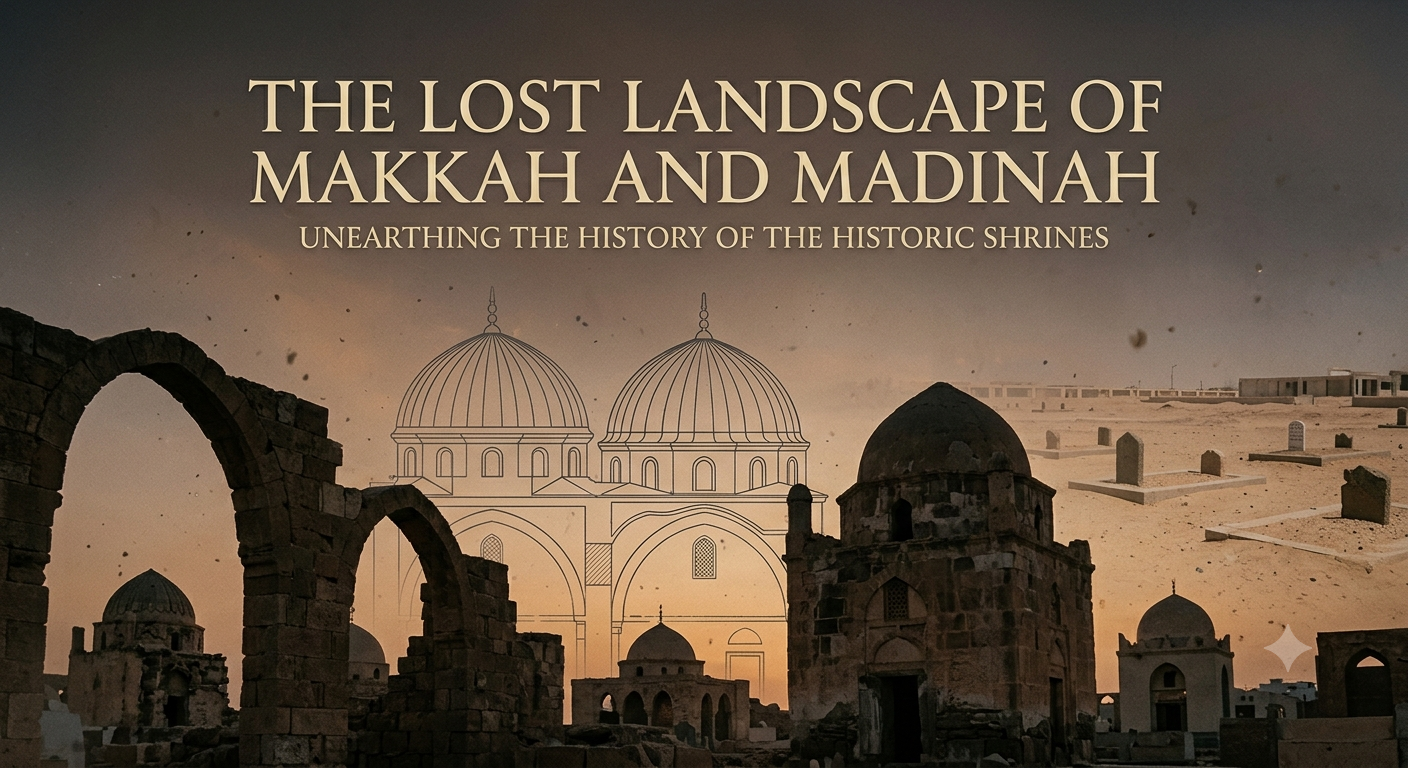
Purane Islamic sources, travellers ke accounts aur historical records se ek kahani
Aaj agar aap Makkah aur Madinah ki pictures dekhen, to naturally aapko lagega ke in muqaddas shehron ka landscape hamesha se aisa hi raha hoga.
Lekin…
history mein Makkah aur Madinah aaj se kaafi different nazar aate the.
Aur iska sabse interesting evidence humein kisi random social-media post se nahi, balki Muslim historians, travellers aur baad ke archival records se milta hai.
Jannat-ul-Baqi mein kabhi multiple domes aur mausoleums the.
Makkah ke Jannat-ul-Mu’alla mein important graves ke upar structures maujood the.
Aur Makkah mein Nabi ﷺ ki wiladat se associated ek jagah ko bhi centuries tak log pehchante aur visit karte rahe.
Phir in structures ka kya hua?
Aur kis wajah se hua?
Chaliye timeline se samajhte hain.
Sabse pehle: Kya Nabi ﷺ ki wiladat ki jagah historically identify ki jaati thi?
Is point ko samajhna important hai.
Makkah ke early historians mein Muhammad ibn Ishaq al-Fakihi (d. 9th century) ki Akhbar Makkah ek important source hai.
Al-Fakihi Nabi ﷺ ki wiladat se associated ghar ka zikr karte hain aur likhte hain ke ye ghar Dar Ibn Yusuf mein tha.
Woh ye bhi record karte hain ke al-Khayzuran, jo Abbasid caliphs al-Mahdi ki wife aur al-Hadi aur Harun al-Rashid ki walida thi, is jagah ko alag karke masjid bana diya tha, jahan namaz padhi jaati thi.
Yani Nabi ﷺ ki wiladat se associated location ko early Islamic Makkah mein religious significance hasil thi.
Reference:
- Muhammad ibn Ishaq al-Fakihi, Akhbar Makkah fi Qadim al-Dahr wa Hadithihi, vol. 4, section on places where prayer is recommended and the relics of the Prophet ﷺ.
Al-Fakihi ka text is baat ka important early documentary evidence hai. [1]
Aur phir Ibn Jubayr Makkah aate hain
Ab history mein ek aur fascinating record milta hai.
Andalus ke famous traveller Muhammad ibn Ahmad Ibn Jubayr 579 AH / 1183–84 CE ke around Makkah pahunche.
Unki Rihla sirf travel diary nahi hai.
Ye 6th century Hijri ke Makkah aur Madinah ko samajhne ke liye important eyewitness source hai.
Ibn Jubayr Nabi ﷺ ki wiladat ki jagah ke baare mein likhte hain ke Rabi al-Awwal ke Mondays par is blessed place ko khola jaata tha aur log andar jaakar tabarruk hasil karte the, kyunki isi din aur isi mahine Nabi ﷺ ki wiladat hui thi.
Yani yahan humein 12th-century Makkah ka ek eyewitness account mil raha hai.
Aur ye point important hai:
Ye modern Mawlid debate ka social-media claim nahi hai.
Ye ek medieval Muslim traveller ka recorded observation hai.
Reference:
- Ibn Jubayr, Rihla / The Travels of Ibn Jubayr, description of Makkah, section concerning the Prophet’s birthplace. See also the commonly cited edition, pp. 114–115.
Ab chaliye Jannat-ul-Baqi
Jannat-ul-Baqi ko aaj hum ek simple cemetery ki tarah dekhte hain.
Lekin historical records se pata chalta hai ke Baqi ka physical appearance hamesha aisa nahi tha.
Madinah ke great historian Ali ibn Ahmad al-Samhudi (d. 911 AH / 1505 CE) ne apni famous kitab:
Wafa al-Wafa bi Akhbar Dar al-Mustafa
mein Madinah ke historical sites, graves, mosques aur ziyarat ki jagahon ka detailed record diya.
Unki kitab Baqi ke structures aur unki history ke liye important primary historical source hai.
Al-Samhudi ke record mein Baqi ke andar multiple important graves aur unke surrounding structures ka zikr milta hai.
Baad ke historical records mein bhi in structures ki maintenance aur reconstruction ka zikr aata hai.
For example, Baqi mein renovation ka ek important record 519 AH ka hai, jab Abbasid Caliph al-Mustarshid ke order par construction/renovation work hua.
Reference:
- Nur al-Din Ali al-Samhudi, Wafa al-Wafa bi Akhbar Dar al-Mustafa, vol. 3, p. 916, for the 519 AH renovation record.
Lekin ek aur powerful source hai: ek European traveller
Ab yahan history aur interesting ho jaati hai.
1814–1815 mein Swiss traveller Johann Ludwig Burckhardt Hijaz mein tha.
Usne Makkah aur Madinah dono visit kiye.
Uski book:
Travels in Arabia
aaj bhi 19th-century Hijaz ko samajhne ke liye ek important eyewitness source hai.
Aur Burckhardt ne Baqi ko apni aankhon se dekha.
Uske account mein ek extraordinary detail milti hai.
Woh likhta hai ke Baqi mein pehle tombs ke upar small domes aur buildings hua karte the.
Aur uske waqt unke ruins ab bhi point out kiye ja rahe the.
Burckhardt specifically records that the ruins of structures that had formerly covered the tombs of Uthman, Abbas, Fatimah and the aunts of Muhammad were attributed to the Wahhabis.
Lekin yahan ek important point hai:
Burckhardt sirf ek side ki story nahi deta.
Woh ye bhi observe karta hai ke cemetery ki poor condition ka kuch hissa local neglect se bhi related tha.
Yani ek serious historical article ko sirf convenient sentence quote karke baaki context hide nahi karna chahiye.
Reference:
- John Lewis Burckhardt, Travels in Arabia: Comprehending an Account of Those Territories in Hedjaz Which the Mohammedans Regard as Sacred, London, 1829, vol. II, pp. 362–363.
To 1806 mein kya hua?
19th century ke beginning mein First Saudi State aur Wahhabi movement ke expansion ke saath Hijaz ka political control change hua.
1805–1812 ke period mein Wahhabi forces Medina par direct ya indirect control mein rahi.
Modern academic reference Encyclopaedia Iranica ke mutabiq, is period mein tombs aur domed shrines destroy kiye gaye.
Aur jab Ottoman-Egyptian forces ne baad mein Hijaz dobara capture kiya, to kai structures reconstruct bhi kiye gaye.
Reference:
- Encyclopaedia Iranica, entry “Shiʿites in Arabia,” discussion of Wahhabi control of Medina, 1805–1812, destruction of tombs and subsequent Ottoman reconstruction.
Lekin yahan ek bahut important historical distinction hai:
1806 ki demolition ke baad story khatam nahi hui thi.
Structures dobara banaye gaye.
Aur isi wajah se humein 19th aur early 20th century ki photographs mein Baqi ka completely different landscape nazar aata hai.
Ottoman period: Baqi phir se rebuild hua
Ottoman rule ke dauran Hijaz mein kai religious structures ko restore aur rebuild kiya gaya.
19th century ke travellers ke accounts is baat ka evidence provide karte hain.
British Library aur Qatar Digital Library ke preserved historical material mein Baqi ki photographs available hain jisme demolition se pehle ke domes aur mausoleums clearly visible hain.
Yani hamare paas:
written history bhi hai,
eyewitness accounts bhi hain,
aur
photographic evidence bhi hai.
Aur phir 1926…
Ab kahani ka sabse well-documented modern chapter aata hai.
Saudi forces ne 1924–25 mein Hijaz par control establish kiya.
Aur 1926 mein Jannat-ul-Baqi ke remaining mausoleums aur tomb structures destroy kar diye gaye.
Modern academic literature is demolition ko Wahhabi religious doctrine ke context mein discuss karti hai, jahan graves ke upar structures aur unse associated veneration ko problematic samjha jaata tha.
Encyclopaedia Iranica specifically record karti hai ke April 1926 mein al-Baqi ke tombstones aur mausoleums ko destroy karne ka order diya gaya.
Reference:
- Encyclopaedia Iranica, “Shiʿites in Arabia,” section discussing the 1926 destruction of al-Baqi.
Aur is baar hamare paas photographs bhi hain
Ye point particularly important hai.
Agar koi kahe:
“Baqi mein kabhi domes the hi nahi.”
to historical photographs iska jawab deti hain.
Museum With No Frontiers ke Islamic Art database mein early-20th-century Baqi ki photographic documentation preserved hai.
Photographs mein multiple domed structures aur mausoleums clearly visible hain.
Reference:
- Museum With No Frontiers, Photographic Postcard of the Cemetery of al-Baqi, early 20th century.
British archives mein bhi controversy ka record hai
Aur yahan ek aur interesting piece of evidence milta hai.
British National Archives mein India Office Records ki ek file preserved hai:
“Hejaz and Indian Muslims. Desecration of tombs by Wahabis, etc.”
File reference:
IOR/L/PS/12/2111
Date:
1930–1933
Yani 1926 demolition ke kuch hi saal baad Indian Muslims ne is issue ko international political level par raise kiya.
Archival material mein Indian Muslim representatives ki appeals preserved hain concerning the destruction of shrines and monuments in the Hijaz.
Reference:
- British Library / The National Archives, India Office Records, IOR/L/PS/12/2111, Hejaz and Indian Muslims. Desecration of tombs by Wahabis, etc., 1930–1933.
Ye ek important point establish karta hai:
Baqi ki demolition koi modern internet controversy nahi thi.
Us waqt bhi Muslims is issue ko publicly aur politically raise kar rahe the.
Lekin sirf Madinah hi nahi…
Ab Makkah chalte hain.
Makkah ka historic cemetery:
Jannat al-Mu’alla
ya al-Hajun.
Yahan Nabi ﷺ ki beloved wife Sayyidah Khadijah رضي الله عنها aur early Islamic history ki kai important personalities madfoon hain.
Historical descriptions mein is cemetery ke andar important graves aur structures ka zikr milta hai.
Aur 20th-century Saudi period ke dauran yahan bhi historical tomb structures remove kiye gaye.
Isliye destruction ka pattern sirf Madinah tak limited nahi tha.
Makkah bhi is historical transformation se guzra.
Ab asal question: ye sab destroy kyun kiya gaya?
Yahan emotions ko side par rakh kar theology ko samajhna zaroori hai.
Muhammad ibn Abd al-Wahhab ki writings mein graves, tomb structures aur intercession ke issues central theological concerns mein se the.
Modern historian David Commins apni book The Wahhabi Mission and Saudi Arabia mein explain karte hain ke Ibn Abd al-Wahhab ke theological framework mein graves aur shrines se associated practices ko shirk ke khatre ke context mein dekha gaya.
Commins specifically Ibn Abd al-Wahhab ke writings aur tomb visitation/intercession ke issue ko discuss karte hain.
Reference:
- David Commins, The Wahhabi Mission and Saudi Arabia, I.B. Tauris, 2005, especially Chapter 2, “Holding Fast Against Idolatry,” pp. 40–70.
Isi tarah Natana J. DeLong-Bas apni academic study Wahhabi Islam: From Revival and Reform to Global Jihad mein graves, shrines aur intercession ke issue par Ibn Abd al-Wahhab ke views ko discuss karti hain.
Reference:
- Natana J. DeLong-Bas, Wahhabi Islam: From Revival and Reform to Global Jihad, Oxford University Press, 2004, chapter discussing shrines, mosques, tombs and visitation.
Yani demolition ke peeche ek clear theological reasoning thi.
Ye random destruction nahi thi.
Ye ek particular interpretation of Islamic reform ka part thi.
Lekin yahan ek aur side bhi hai
Agar hum sirf modern Saudi/Wahhabi explanation padhenge, to humein ek side samajh aayegi.
Agar hum sirf anti-Wahhabi literature padhenge, to doosri side.
Isliye historical research ka better tareeqa hai:
primary sources dekho.
Ibn Jubayr ko padho.
Al-Fakihi ko padho.
Al-Samhudi ko padho.
Burckhardt ko padho.
Purani photographs dekho.
Ottoman records dekho.
British archival correspondence dekho.
Phir modern historians ko padho.
Tab picture zyada clear hoti hai.
Ek important correction: “1300 saal se same shrines the”
Yahan ek claim se bachna zaroori hai.
Social media par kabhi kabhi kaha jaata hai:
“Ye shrines 1300 saal se continuously isi form mein maujood the aur phir Ibn Abd al-Wahhab ne aakar sab destroy kar diya.”
History itni simple nahi hai.
Structures different periods mein banaye, rebuild aur renovate kiye gaye.
Kuch structures early Islamic period ke nahi the.
Kuch medieval period mein develop hue.
Kuch Ottoman period mein reconstruct hue.
Aur phir 18th–20th centuries mein different demolitions hui.
Isliye zyada historically accurate statement ye hai:
Makkah aur Madinah mein important graves aur religious sites ke upar centuries ke dauran architectural structures develop hue, jinmein se kai structures Wahhabi-Saudi conquests ke dauran destroy hue, kuch Ottoman period mein reconstruct hue, aur 1920s mein kai structures dobara demolish kar diye gaye.
Ye statement evidence ke zyada close hai.
Aur isi wajah se purani photographs important hain
Aaj Jannat-ul-Baqi dekhiye.
Simple graves.
Open cemetery.
No large mausoleums.
Lekin 19th aur early 20th century ke records dekhiye…
domes nazar aate hain.
Mausoleums nazar aate hain.
Architectural structures nazar aate hain.
Aur phir demolition ke records dekhiye.
Suddenly picture connect hone lagti hai.
To history humein kya batati hai?
History humein ye nahi batati ke har dome automatically Islam ka necessary part tha.
Aur history ye bhi nahi batati ke har structure shirk tha.
Ye theological questions hain, aur Muslims ke different schools in par different positions rakhte hain.
Lekin history ek cheez definitely document karti hai:
Makkah aur Madinah ka physical landscape time ke saath dramatically change hua hai.
Aur is change mein graves, mausoleums aur historical religious sites ki demolition bhi ek important chapter hai.
Is chapter ko samajhne ke liye humein memes nahi…
books kholni hongi.
Travelogues padhne honge.
Old photographs dekhni hongi.
Archives check karne honge.
Aur sabse important—
sources ko khud padhna hoga.
Kyunki kabhi-kabhi history ka sabse interesting part woh nahi hota jo aaj humein nazar aa raha hai…
balki woh hota hai:
jo kabhi wahan tha, aur aaj wahan nahi hai.
Primary Sources & Further Reading
Early Muslim Historical Sources
1. Muhammad ibn Ishaq al-Fakihi — Akhbar Makkah fi Qadim al-Dahr wa Hadithihi
Early historical account of Makkah. Particularly relevant for the historical identification of the house associated with the Prophet ﷺ’s birth and its later use as a place of prayer.
2. Muhammad ibn Abdullah al-Azraqi — Akhbar Makkah wa Ma Ja’a Fiha min al-Athar
One of the foundational works on the history, geography and sacred sites of Makkah.
3. Ibn Jubayr — Rihla
First-person travel account of his pilgrimage to Makkah and Madinah in the 6th century AH. Particularly important for descriptions of the Prophet ﷺ’s birthplace and medieval Makkah.
4. Nur al-Din Ali al-Samhudi — Wafa al-Wafa bi Akhbar Dar al-Mustafa
One of the major historical works on Madinah. Particularly important for the history of al-Baqi, the Prophet’s Mosque and the city’s sacred sites.
5. Taqi al-Din al-Fasi — Shifa al-Gharam bi Akhbar al-Balad al-Haram
Major historical work on Makkah, its sacred sites and places of visitation.
Eyewitness / Travel Sources
6. John Lewis Burckhardt — Travels in Arabia: Comprehending an Account of Those Territories in Hedjaz Which the Mohammedans Regard as Sacred
London: Henry Colburn, 1829, 2 vols.
Burckhardt personally visited Makkah and Madinah shortly after the first Saudi-Wahhabi conquest and recorded the condition of the cemeteries and surviving ruins.
Modern Academic Studies
7. David Commins — The Wahhabi Mission and Saudi Arabia
London: I.B. Tauris, 2005.
A modern academic history of the Wahhabi movement and its political alliance with the House of Saud.
8. Natana J. DeLong-Bas — Wahhabi Islam: From Revival and Reform to Global Jihad
Oxford: Oxford University Press, 2004.
Useful for understanding the theological arguments concerning graves, shrines, intercession and religious reform.
9. Madawi Al-Rasheed — A History of Saudi Arabia
Cambridge: Cambridge University Press.
Useful for the political history of the Saudi state, including the conquest and incorporation of the Hijaz.
Archival & Photographic Evidence
10. British Library / Qatar Digital Library — India Office Records, IOR/L/PS/12/2111
Hejaz and Indian Muslims. Desecration of tombs by Wahabis, etc., 1930–1933.
11. Museum With No Frontiers — Historical photographs of al-Baqi
Photographic documentation of the cemetery and its pre-demolition structures.
A note about the sources
Is article mein primary Muslim historical works ko modern academic scholarship ke saath use kiya gaya hai.
Jahan kisi historical source mein kisi event ka claim hai, use automatically theological proof nahi samajhna chahiye.
Aur jahan modern historians kisi event ki interpretation dete hain, us interpretation ko primary source ke barabar nahi samajhna chahiye.
History ko samajhne ka best tareeqa hai: source ko source ke taur par padhna.
Leave a Reply